Thursday, November 8, 2012
Part Two: Ruined
What are we to make of these withered stumps of time that have become a part of the city’s existing condition? I hope to pursue an understanding of urban decay by conducting research that will present us with an opportunity to know what these spaces have become, and what potential they hold.
Sadly, as it currently stands our ability to decide how we should judge the potential that voids and wastelands hold is deeply impaired. The reason being that the unclaimed buildings and the un-authorized activities that occur in them are generally divided by society into opposing binaries. Most often it is a positive or negative lens that is used. One side equates urban decay with dereliction, social decline and waste. The other side represents ruined sights as places of inspiration, a repository of memory, generators of creativity, places of habitation and performance. It is a limiting viewpoint that blocks the way to inquiry (i.e. to understanding these buildings or studying their current and potential use), and in turn prohibits growth (i.e. the possibilities that these structures contain good or bad)—one that should be challenged.
My time at the Rock has shown me that the rusting mills and deserted sooty brick houses have great potential—one that cannot be simply seen as good (the buildings are a beacon for creative spirits) or bad (the buildings are decrepit and dangerous). Put another way, the possibilities that exist within these structures cannot be divided into two groups that are separated by an immaculate border. Instead, the two categories should be seen as distinct but connected—an ambiguous tension in an ever-shifting realm.
What type of study will present us with an opportunity to know what these spaces have become and what potential they hold? I believe if we are to see the space as it is, with its complex layers of interaction between the built environments, the derelict and the wild then it is crucial to start from where we are. One-way to address the question is by determining what kind of activity the space invites. Ergo, my next step is to attempt to discern what types of activities the bottom of the rock solicits.
Why Ruins: A Personal Reflection on the Black and Yellow Steel City
My interest in urban decay stems from long-term exposure to postindustrial ruins. As a child the abandoned mills of Iron City and the disintegrating Erie Railroad repair shops exerted a magnetic attraction for me. I spray-painted on the worn-down brick walls of the boarded-up mills, which lined the Ohio River. Games of hide-and-seek were not played in a family sanctioned park, but were passionately played in a half-forgotten sight that once housed the mighty Chartiers Creek Railroad. In the not so distant past our shrieks and the pounding of our feet against the pavement echoed through the empty shop floors as we played cops and robbers.
Due to the unorthodox habitat of my upbringing I was exposed at an early age to people of whom society generally paints an unflattering picture as well as to a landscape that the public mostly views as a social blight. Drug dealers, tattoo artists, inhabitants of the “Bottom” Projects, steel mill workers, and members of motorcycle gangs were all daily actors in childhood life. For example, my babysitters did not use umbrellas to fly through the sky or speak with British accents; instead, they used Harley-Davidson motorcycles embellished with pinup girls and spoke with true Pittsburghese accents.
In regards to the landscape, the area in which I played was only a shadow of its former self. Once upon a time, the neighborhood was flourishing with wealth, amenities, and expansive shopping districts—but no longer. Today the streets and avenues that once contained restaurants and libraries now contains bars, illegal strip clubs, and underground gambling. The factories and workshops that once shook with the roar of machines and the yells of workers now stand empty next to the smokeless smokestacks. A semi-ghost town might seem like an unfortunate playground—a social blight that can only foster delinquent activity. But, it was the abandoned buildings of the post-industrial revolution, which served as a backdrop for all of my passions and hobbies.
The rock’s inhabitants and abandoned structures broadened my horizons in more ways then I can ever thank them for. I learned of new music, books, comics and artists that I would have never encountered otherwise. I was taught to appreciate graphic novels, street artists, and music ranging from rappers like Formula412 to rock groups like the Buzz Poets. More importantly, I was taken to places, engaged with people, and participated in activities—like skateboarding at Mr. Smalls, raving at the Cork factory, or learning to cook a boiled pierogi with the women of the Holy Trinity Polish Church—that I would have been scared of or not interested in otherwise approaching.
Ultimately, these experiences and interactions not only molded my outlook and hobbies, but they also cultivated an interest that has come to define the course of my life: studying post-industrial unintentional urban voids with the hopes of someday better grasping how “empty” unclaimed spaces are used/understood.
- Rose Macaulay, Pleasure of Ruins (New York: Thames and Hudson, 1953).
- Julia Hell and Andreas Schonle, eds., Ruins of Modernity (United States, Duke University Press, 2010).
- Georg Simmel, "Two Essays: the Handle and the Ruin", Hudson Review, 11:3 (1958: Autumn) 370-384.
- Robert Ginsberg, "Aesthetics of Ruins," Bucknell Review 18:3 (1970: Winter) 89-103.
- http://theboweryboys.blogspot.com/
- http://www.infiltration.org
- http://www.abandonedny.com/
- http://www.opacity.us/
Wednesday, November 7, 2012
Forced Disappearances and the Application of Forensic Anthropology
![]() |
| Image of the desaparecidos from the Mothers of the Plaza del Mayo |
![]() |
| Map of South America |
Further Reading:
Amnesty International Enforced Disappearances
Operation Condor
EAAF Mission Statement
Thursday, October 18, 2012
The Undead, Alive in the Archaeological Record: Vampires
![]() |
| One of the two "Vampire" skeletons found in Sozopol, Bulgaria. Source |
Vampire folklore, and generally fear of the dying and of the dead is among the oldest of anxieties and phobias. Current theory surrounding vampires that have been found in archaeological sites, particularly in Europe, is that these individuals were deviants, criminals, terminally ill or deformed during their lives. Illness demonization may have resulted from a lack of medical or scientific knowledge, though most likely a combination of them both. The cultural response, both modern and historic, to the unknown seems to be fear and violence towards the accused, behaviors or appearances that differed were cast as "other" and, thus, "bad". "Othering" reflects the exclusion or subordination of an individual. Within "vampire" burials, it is reflected in atypical burial practices or physical trauma.
![]() |
| Sorry, Edward. You're more accurately a revenant. |
Included in this cultural response is the name "vampire" itself. The term was not popularized until the 19th century literature, namely Bram Stoker's Dracula. Instead, using "vampire" draws from the popular portrayal of vampires as sympathetic, dynamic, and heroic characters, as seen in Stephanie Meyer's Twilight.
To avoid this, I propose that "revenant" is a more appropriate term as it describes any individual who returns from death, exits their grave, and terrorizes the living, while "vampire" denotes an individual who suck blood from their victims after exiting their grave. Etymology cannot be directly be derived from burial practices, and I would prefer the nomenclature of "revenant" as a more accurate term.
![]() |
| Close view of the iron stake, in the upper right torso area. Source |
In the case of the Sozopol, Bulgarian vampire discoveries, two male individuals were found with a singular iron stake resting in the middle of the skeletonized remains. The burials date back to the 14th century, a time during which the plague ravaged most European countries. Yet there are conflicting and contrsting reports by both National Geographic and the Sofia News Agency. While National Geographic refers to a singular man as a "corpse" and "skeleton", Sofia News Agency refers to both male "individuals". Simple manipulation and precision of language allows for these separate media outlets to construct very different identities for these "vampires".
The presence of metal stakes in the male’s grave suggest that staking his deceased body would prevent his transformation into a vampire in order to protect the well-being of his family or community members. Placing a sharp object in the grave was believed to puncture the body as it bloated, which was the how the deceased was thought to have transformed into a vampire. The sharp object also inhibited a vampire’s bodily movement, and prevented any possible escape from the grave. This evidence, found in the Bulgarian grave at Sozopol is indicative of a belief that this individual was different -- an "other"
The media has a responsibility not only to the archaeologist's work, their journalistic integrity, but also to the deceased about whom they are writing. Using the word "vampire" is itself sensational, as it draws upon the popularity of those creatures within popular culture to gain readership. Though, doing so risks dishonoring the memory of the individual in hopes of making a quick dollar.
Within the archaeological record these "vampire" remains, paired with revenant folklore, narrate a society's reaction to an illness, atypical behavior, or misunderstood postmortem processes. The creation of deviant burials serve to chronicle the process of "othering" during medieval Bulgaria. I take issue with the use of "vampire", "corpse" and "skeleton" by the media as there is a risk of further "othering" those accused of "vampirism" during their lives. The media risks their readership alienating those who were violently demonized. The Bulgarian cultural beliefs are not to be judged or evaluated by our modern audience. Rather, these cultural beliefs should be used, as a lens through which deviant burials can be understood. Additionally, our own popular cultural belief of vampires as sympathetic, dynamic characters should not be projected back onto the past.
Kelsey Kephart
Further Reading:
Anastasia Tsaliki. "Vampires Beyond Legend: a Bioarchaeological Approach" Proceedings of the XIII European Meeting of the Paleopathology Association, Chieti, Italy, 18-23 Sept. 2000. Ed. M. La Verghetta and L. Capasso. Teramo: Edigrafital S.p.A, 2001. 295-300.
Anastasia Tsaliki. "Vampires, the media, and quality control in archaeology". Publishing Archaeology. March, 19, 2009.
Unrelated burials
Venice "Vampire", Plague Victim or Witch?
Vampire Skeletons Mystery by NatGeo
Great New England Vampire Panic
Monday, December 12, 2011
Contemporary African Art: A Critical Reaction to an African Past
In my experience, when talking or learning about aspects of the world, it is discussed in terms of the countries of Europe, the countries of Asia, the countries of the Americas and then the continent of Africa. These views of Africa as a homogenous unit (with perhaps the notable exception of Egypt) do not just occur in conversation—causal discussion between friends and family but it is inherent in our textbooks, classrooms and news sources. I am afraid I am no exception, I often find myself making generalizations about Africa and I am shocked--how is it possible that an area so large and so old has been viewed and internalized as a uniform area.
Contemporary African art has begun to draw attention and confront these generalizations—drawing attention to Africa’s similarity to the rest of the world. There are two cases in which we can see the artist engage in conversation with this accepted lack of understanding.

Contemporary art photographer, David Goldbatt is best know for his photographs depicting South Africa during the apartheid (though is still actively documenting the landscapes of South Africa). Goldbatt is a revolutionary figure in African photography as he initiated a change portraying the rulers and powerful members of society as well as focusing on those being ruled, capturing the struggles and abuses they faced. Goldblatt, a native of South Africa, captures these images and broadcasts them to the rest of the world from within Africa challenging the tradition role of the world looking in and appraising from an external position. Goldblatt describes himself as "a self-appointed observer and critic of the society into which [he] was born, with a tendency to doing honor or giving recognition to what is often overlooked or unseen" (From an article by Bill Kouwenhoven).

Differently the show entitled Snap Judgments: New Positions in Contemporary African Photography curated by Okwui Enwezo was an important and provocative exhibit for African photography and how we look at Africa in general. The show was on display in the western world and examined the way that we, westerners viewed Africa. The self referential aspects of the exhibit—the atrocities portrayed allow the western viewer to sympathize with the victim for an instant but there is the simultaneous realization for the viewer that they are part of the western world with has occupied this space of brutal action against Africans in history (for instance see the Mikhael Subotzky image, I highly recommend checking out the whole Die Vier Hoeke series). This tension in the images throws the view into an uncomfortable contemplative space—evaluating how the “west” sees Africa and how Africa sees the “west. ” These images force the western viewer to confront the truth of the western violence (perhaps not literally, but metaphorical) to African society, history and mostly perspective.
Memphis Brooks Museum of Art Exhibition Review: March 1 - May 25, 2008.
Okwui Enwezor, “Snap Judgments: New Positions in Contemporary African Photography,” in Snap Judgments: New Positions in Contemporary African Photography, ed. Okwui Enwezor (New York: International Center of Photography and Göttingen: Steidl Publishers, 2006).
Sunday, December 11, 2011
The Evolution of Language: Where Archaeology Merges with Science
The answer may lie in more of a scientific and anthropological approach. Observing the current world and using it to infer about the past is a popular strategy for many other topics of archaeology. Many of the theories on hunter-gatherer cultures in pre-historic Africa are based on observations of current hunter-gatherer cultures. And now, closely studying the people and other animal species of today has led to an exciting breakthrough and clues to understanding how language developed.
The idea that acquiring language is a biological facet of humans was originated by Noam Chomsky. Children acquire language too efficiently and effortlessly for it to simply be a social construct. From this, theories followed that we should be able to see some form of evidence of the development of language in the path through our evolutionary ancestors that still survive today, such as chimpanzees. So while archaeology yearns for ancient artifacts about language, perhaps there are records in our DNA.Scientists actually believe they have found one of the most important genes for developing language. The gene is FOXP2, meaning that the gene creates the protein FOXP2. Through studying a unique family and another unrelated young boy, all of who struggle with language in specific ways, they found that all of them had deficiencies in this gene. The scientists then did a bit of "scientific archaeology" on the evolution of this gene. A version of the gene exists in every land vertebrate, and in most specie lineages has remained pretty much unchanged. In the human branch, however, changes to several of the amino acids that make up the protein FOXP2 occured over the course of a few million years, which the scientists took as a sign that this gene experienced rapid natural selection, similar to other features of humans such as our upright posture or large brains.
Further studies have also found that this protein is actually facilitator of many other genes, aiding in the growth of neurons in the brain and fine muscle movements that would be used in creating sounds in speech.Ultimately, the findings on the FOXP2 gene don't answer exactly how language biologically developed in us. It is only a beginning piece for understanding the process. Its value to archaeological studies, however, is still priceless. As we understand this gene (its processes and functions as well as its development) more, we can then look for indirect clues of its evolution in the archaeological evidence. For instance, maybe we won't be able to see direct signs of the first spoken language, but if we learn of other physical changes that this gene created as it evolved, then perhaps we could find pieces of evidence indicating these physical alterations and then infer that at this time humans could have been speaking. Already connections can be made (albeit fairly thin connections). The FOXP2 gene, as previously mentioned, helps to facilitate the learning of new motor skills. When humans developed, they had to learn a whole range of new motor movements associated with being human, like running and calling. These changes, as observed through archaeological study, are already evidence that this gene was actively helping us to evolve into present day humans. Hopefully with further study and understanding of the FOXP2 gene we will be able to draw even more connections about how it helped us develop more complex brains and master complex sounds, leading to the first words spoken between ancient humans.
-Chris Vandenberg
Sources:
Discover Magazine: The Language Fossils Buried in Every Cell of Your Body
FOXP2 and the Evolution of Language
Monday, December 5, 2011
A Face Only an “Altruistic Homo” Mother Could Love?
the cranium is twisted to the left with respect to the sagittal plane; the left glenoid cavity is more
anteriorly placed than the right one. Source and adapted text
Theory surrounding our ancestor’s capacity for love and affection are unclear. The exact nature of ancient companionship have yet to be concretely established, leaving theories surrounding child care unclear even still. Yet, the discovery of a juvenile skull displaying a condition known as craniosynostosis allows paleoanthropologists to consider the presence of physical and possible mental handicaps in our history, dated to be 530,000 years ago. What commentary does this provide on the parental and emotional capacities of our Homo ancestors?
Dating from the Middle Pleistocene period, the skull has been identified as an “immature specimen” aged approximately 5-8 years at death. Discovered in 1976, the specimen’s cranial deformities continue to be the focus of debates surrounding the limits of compassion that the species Homo could convey towards their young. Craniosynostosis is a congenital birth defect that affects the structure of the infant’s head. The defect causes the one or more sutures that run along the skullcap to fuse prematurely. This constricts the growth of the brain, causing contortion of the skull into a long and narrowed shape, motor impairment, aneurysms, and mental retardation if intracranial pressure is severe enough and left uncorrected.
What can we NOT infer from this discovery? We cannot infer the exact level of mental impairment that the child suffered from. Likewise, we cannot infer the exact cause of death. Craniosynotosis is associated with intracranial pressure, which can cause a laundry list of syndromes including but not limited to the aneurysm and mental retardation previously mentioned. Because of this, we can neither infer to what extent the child was treated similarly, or different, than Middle Pleistocene Homo individual.
Virtual endocast of the skull. Note the general bilateral asymmetry, the occipitomastoid bulging of the left side, the anteriorly placed left temporal lobe compared with the right, and the protruding left occipital pole. Source and adapted text
What we can infer is that the child did receive some form of care. Gracia, who is responsible for the uncovering of the skull stated that, "It is obvious that [this] hominin species did not act against abnormal/ill individuals during infancy." Generally speaking, it would be unlikely for even a modern child to survive without a constant source of food, care, or contact. Because of the cranial deformities present in the child’s skull it is unlikely that food gathering would have been a task undertaken by this individual. At the most basic level, a constant supply of food and/or care was provided for this individual which, in turn, allowed for survival.
What we could we infer? We could infer that there had been enough resources within the group, most likely made up of several individuals, to accrue enough excess resources (the remains were found within a group of 28 other skeletal remains, all of European Middle Pleistocene Neandertal lineage). These surplus resources could have been used to either support the disabled child, or to support the primary care giver who may have been required to devote more energy to parental care than to other tasks. What can be said concretely is that a characteristic of the genus Homo was bipedal. Depending on the severity of impairment, the child may have had limitations on its motor coordination, and therefore, in the ability to be motile. A medium to large group capable of accumulating excess resources or the ability to have an individual devote more energy towards the child may have been necessary to its survival past infancy.
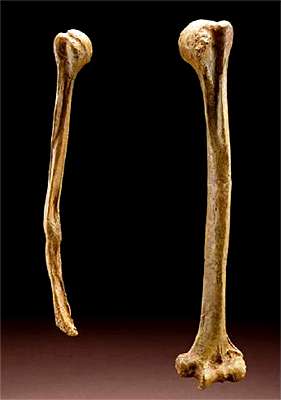
Even though this is the earliest case recorded of craniosynotosis, there have been other examples of individuals displaying altruistic characteristics. In one of the more well-known is “Nandy” the skeletal remains of a man in an Iraq cave who displayed fracture on the left side of his face leaving him blind in one eye, an atrophied right arm as a result of several fractures and the absence of a lower right hand. These injuries most likely occurred during adolescence, and yet he was aged between 40 and 50 years old.
In an interview conducted by Wired.com’s section of Weird Science, Dr. Penny Spikins, who co-wrote The Pre-History of Compassion, comments on the possibility of a society displaying altruism at the Shanidar Cave site:
“We look in the archaeological record for evidence of individuals who were sick, and not able to care for themselves. We see that in early Homo, and by the time we get to Neanderthals, that kind of record becomes much more extensive.
ase of his legs, would have had difficulty walking, and had a crushing injury to his cranium, so he was probably blind in his left eye. The bones show those injuries occurred when he was adolescent, and he lived to 40. He was probably looked after for 25 to 30 years, which implies that it wasn’t just one person looking after him, but several. Most of our Neanderthal skeletons show some evidence of having been looked after for their injuries. And in the age of Neanderth
als, you also start to see evidence of deliberate burials and funerary rites. That means a shared feeling.”
Withered right humerus compared to robust left humerus. Photo: Chip Clark
Smithsonian Institution. Source and adapted text
The problem with these inferences in both case studies is that we have no way of judging the developmental merit, the evolutionary significance or if not acting against the child was considered “right” or “good”. In short, we have no sense of what was normal for the time period. The contribution of this publication, and with paleoanthropology in general, is that it allows for a personal narrative. Because of the sole discovery of such a skull displaying this congenial birth defect, altruism cannot (and should not) be attributed to an entire society’s’ practices, we are only privy to the individual’s, and his or her caretaker’s, story. Though, the same benefit also poses a problem. We cannot draw overarching conclusions from these pieces of evidence presented in the article and one’s similar to it.
Further skeletal remains showing similar physical deformities may be missing from the archaeological record because of mistreatment. They may have been abandoned as infants or even disallowed from being buried in cemeteries belonging to the society. Further evidence is needed to draw a definitive conclusion about the limits or capabilities of altruism, though these case studies provides an insight about the capabilities that our Homo ancestors could have, pertaining to compassion and resource allocation. If we had access to more examples of individuals surviving deformities, how could we look at altruism? Is the behavior a result of a higher categorization of morality, affection, empathy, or accident? Is it possible to distinguish the intangibility of emotion through the archaeological record?
Further reading:
The Neanderthal Skeletal Remains from Shanidar Cave, Iraq: A Summary of Findings to Date
Sources
The Prehistory of Compassion: Neanderthals Cared Too
Deformed skull of prehistoric child suggests that early humans cared for disabled children
The Sima de los Huesos crania (Sierra de Atapuerca, Spain). A comparative study