Monday, November 28, 2011


In the beginning of our African Archeology class, we were asked to write down what Africa meant to us. While it was a rather open ended question, I still had difficulty answering it. Should I mention the origin of human evolution, the hot weather, or maybe even the troubling history of apartheid? While my mind flirted with all of these rather serious topics (especially the hot weather), I ultimately decided to write about New Year’s.

For as long as I can remember up until 2008, my family would meet every December 31st to celebrate New Year’s with certain family friends. However, this was never a standard New Year’s party. Wine was replaced with hot apple cider, and pounding dance music with calming classical choruses. The center piece of the celebrations though was always the slide show of this family’s travels in South Africa. The husband of this family grew up in what was then Rhodesia before moving to Cape town, and he with his wife and children would travel about once a year to see his extended family back in Africa. Yet the slide shows we saw were not filled with pictures of antique grandmothers or third cousins twice removed. Instead, what we saw every New Year’s was a collage of various game reserves visits this family went to during their down time in South Africa.

As a child, these slide shows were a marvel to look at. While things were boring in suburban New Jersey, Africa seemed like such an exciting place where one could see elephants, lions, and zebras. These images led to an association of Africa of a place filled with adventure and exoticism. I was the explorer, seeing wild animals in their natural habitat. Yet I wasn’t only the adventurer, but the scientist as well. Each slide was accompanied with a question to see if I was paying attention. For example, I would be asked “how many zebras do you see in this picture?” after a particular slide (one that probably contained zebras). Three, I would answer triumphantly, only to soon learn that there was a hidden fourth and fifth zebra whose only visible vestiges were a stray leg and a partially visible tail, camouflaged by the other animals. Like Batman trying to escape some demonic test by the Riddler, I felt like my very survival depended on answering these questions correctly. Succeed, and I would earn the respect of my family friends. Fail, and earn eternal damnation. These questions were not restricted to number games, but also identifying different animals from one another. While almost anyone can tell the difference between a lion and a tiger, give me a thumbs up if you can identify a springbuck from a waterbuck. Hint: it involves a white circle and a backside. No joke.

While I would not like to overemphasis these New Year’s parties in sculpting my vision of Africa, I still think these visits were important. To this day, I still associate Africa with the “new frontier,” a place of discovery and exploration. Additionally, I still have the tendency to put different animals into different categories as soon as I see them, such as predator or prey, whether on national geographic or in the street. This tendency, or perhaps fixation, to categorize Africa reminds me of what current New York University Professor Mary Louise Pratt describes as “The Project of Natural History.” She describes how various European writings during the 19th century of Africa used multiple different methods in codifying Africa as the “other.” One such method was to see Africa through a lens of ordered history. Every plant, animal, and person had to be put into their respective categories like toys into the proper bin. Only then could Europe expect to understand Africa. As Pratt writes in Scratches on the face of the Country, “Their [the explorer-writers] task was to incorporate a particular reality into a series of interlocking information orders-aesthetic, geographic, mineralogical… and so on (Pratt 125).” Just like these early explorers who artificially prescribed their own meaning onto Africa through categorizing different genera (I always try to whip that word out when I can) of plant life, I was in a way doing the same. Sure, I was a ten year old looking at animal slides on New Years, but perhaps subconsciously I was boxing in Africa as strictly a place where one could see wild animals. Through putting animals into different groups, I was better able to understand, and perhaps control, the “other” that was Africa.

I am not implying I did anything wrong as a ten year old looking at those slides. But it is important to note from where we have certain pre conceived notions about certain places, and realize they never paint the complete picture. It is fine to appreciate the rich wildlife that is home to Africa, but it is not fine to see it strictly as the continent with animals.

Sources

Roberson, Susan L., and Mary L. Pratt. Defining Travel: Diverse Visions. University of Mississippi, 2002. Print.

Saturday, November 26, 2011

Maasai Meets the United States

My high school created a program in the 1990s called Global Week, in which the students forget about learning by books and lectures and instead, during the first week back from winter break, turn to speakers, performances, documentaries, and “Global Investigator” trips to China and India. Throughout my three years at the school, we welcomed eye-opening experiences over the years that greatly broadened our horizons, including a talk by Pulitzer Prize winner Nicholas Kristof, a performance by Peking acrobats, a film “Made in LA,” and, of course, a trip to China for 10 days to understand a first-hand account of women migrant workers. However, the most memorable event of all came in my senior year when I least expected it.

Tuesday of Global Week I was enchanted by Nicholas Kristof. Global Week usually has one star of the show every year—before I came to the school Al Gore and Jane Goodall were the token stars of previous years. I could tell Nicholas Kristof was the big star of my last Global Week, and I soaked it in. The subsequent speakers were informative and interesting, but not moving to the extent of Kristof, and I didn’t expect them to be. On the last day, the classes broke off to do different activities. As the last event, I was prepared for a low-key project, or maybe a local speaker who would guide us in helping the global community in some way. Instead, a man who physically resembled a flagpole dressed in traditional Maasai clothing walked through the door.

Students and teachers were in awe -- the visitor provided a shock to all. The speakers we were accustomed to were scholars, journalists, photojournalists, film directors, and leaders. The moment he walked into the room, nobody said a word. There were no whispers. Nobody looked around. He introduced himself as a regular member of the Maasai people and a governmental representative within his more immediate group in Kenya, explaining why he made the unusual trip to the United States.

He began his talk, or informal getting-to-know-you session, with a warrior jumping dance and chant. (Tourist bloggers' account of the same visual.) Tall stick in hand, lion skin strewn across his back, and beaded necklaces all moved with him in a completely vertical, basketball-star worthy succession of jumps. As he danced, he sang a warrior song that he explained varies from group to group. He continued to tell us about their coming-of-age rituals in which young boys cannot show any sign of pain while someone pulls out several of their teeth. Boys are also only considered men when they kill their first lion—the group can help wound it, but the boy must deliver the final blow. The people primarily survive off of a diet of blood and milk from a cow. They do not kill their cattle for meat, but instead milk the cows and delicately extract blood from their veins. Occasionally they will eat meat from the animals they hunt and eat whatever grains they can grow in their regions. Families or small tribes will cluster together and serve as a central unit similar to the way in which a town might function here. His tribe owns one car that would make one trip to the capital once a week. Additional technology they capitalize on is cell phones. Hunting becomes much less dangerous and more synchronized when members of the hunting group can encircle the animal and call each other to go in for the kill.

I left that day knowing I would always have a vivid movie reel of the tall Maasai warrior in my mind because he surprised me. The juxtaposition of Maasai and Silicon Valley was irreconcilable. Hearing about sweatshop labor, human trafficking, and tens of other tragic problems the world faces today is heart-wrenching and moving, but somewhat expected and already percolating in our minds. We rarely have the chance to simply learn about another culture in its pure form. Sometimes I think back and reflect upon that day to recapture the feeling of utter surprise at a cultural difference I never knew existed. Sometimes I mention the day in relevant conversation to see people’s reactions to, “at least our toughest assignment is a paper or an exam – a man who lives in Kenya told me in his culture you have to endure lion hunting and having your teeth pulled out as a coming-of-age experience.” However, I lacked the tools and understanding to put this one man’s account into a larger social account and narrative, and, therefore, my thoughts never reached beyond those two points.

In the context of this course, the man’s presentation reinforces the idea that the West views Africa as both a place of origins and stuck in the past. In no way was the school trying to degrade the culture – in fact, they were trying to enhance our knowledge and promote acceptance and understanding of different cultures. Though the way the information was presented unintentionally treated the man and Maasai as a novelty.

With our iPhones in hand, we saw the man to be somewhat primitive, a way in which we could study what “Africa,” already a blanket term and gross generalization, might have been in the past and how it is now. (Our teachers had warned us to be sensitive to their deep-rooted, traditional culture, suggesting they lived by traditions that have been unchanged over hundreds of years. In our minds, the only difference between them then and now is their cell phones and one Jeep.) However, maasaieducation.org makes a point that, “On their migratory route South, Maasai, who are dreaded for their warlike tendency and reputation, forcibly displaced tribes that they encountered on their migration South.” This one piece of history we never received already disproves this preconceived notion we accepted when we absorbed this man’s culture out of context. Maasai today, spanning a vast region of East Africa from Kenya to Tanzania, did not originate from those areas. They moved south from Northern Africa and settled by the seventeenth century. Already we see a battle between fact and Western notions that Africa is “unchanging.”

The idea that our visitor was viewed as a novelty stems from the stark contrast of our environment and the man’s lack of context. In the heart of Silicon Valley, it’s easy to assume not many people like him in the world exist today. That is a completely false assumption, to say the least. In fact, there are about 1.5 million Maasai in Kenya and Tanzania. However, Maasai are aware of the Western idea that they are extraordinary and a rarity. In an article entitled, “Maasai and the Lion King,” Bruner explains there are several vacationing destinations run by Maasai to cater to the West’s image of them. In a description of three different resorts and vacationing spots, Bruner states, “To summarize thus far, Mayers presented the tourist image of the African primitive, Bomas presents the preservation of a disappearing Kenyan tradition, and the Sun-downer an American pop-culture image of Africa” (Bruner). Surprisingly, Maasai do not aim to downplay the assumptions that they are in any way “stuck in the past” or have some “primitive” qualities. Instead, they use their image in the West’s mind to create a portion of their economy, an act in itself that disproves the West’s assumptions in the first place.

Bruner describes in more detail:

“The Maasai, of course, are well aware of the discrepancy between their own life-styles and their tourist image, and they manipulate it, but there are many complexities in the situation. Some Maasai, who have in effect become performers in the tourism industry, display themselves for tourists, to be observed and photographed, and if asked, they reply that they do it for the money. They play the primitive, for profit, and have become what MacCannell (1992) calls the ex-primitive. This is the case for per-formers at all three sites, at Mayers, Bomas, and the Sundowner. Tourism for them is their livelihood, a source of income. On the other hand, I knew one Maasai business executive who assumed "ethnic" Maasai traits only during his nonworking hours. He dressed in Western clothing with shirt and tie during the work week in Nairobi, where he spoke English, but on most weekends, wearing jeans and a T-shirt, and speaking Maasai, he would return to his native village to become a pastoralist to attend to his extensive herd of livestock” (Bruner).

There certainly is tension between outside pressures, ties to tradition, and a natural progression of change and development within Maasai culture. As mentioned in the Bruner article, some Maasai do not strictly adhere to traditional culture, exemplified by what we call “casual Friday” weekend dress. On the other side of the spectrum, many of the coming-of-age traditions are still prevalent and a cornerstone of being Maasai. However, there’s an interesting blend with the example of our school visitor. One of his main activities revolves around hunting, performing hunting rituals, and wearing traditional hunting clothes. Though this is grounded in the traditional men’s role in his society, they use cell phones to enhance their hunting experience. Some traditions are more important to certain Maasai than others, but many of their experiences and ways of life today point to a clear departure from the West’s idea that they are unchanging and demonstrate instead their progression.

My school experience and further reflection raises the question: Can cultural education serve not to enhance our perspective but only put us more in the dark? If that’s true, how can we avoid this hard realization?


Sources:

http://news.bbc.co.uk/2/shared/spl/hi/picture_gallery/07/africa_maasai_ceremony/html/3.stm

The Maasai and the Lion King: Authenticity, Nationalism, and Globalization in African Tourism
Edward M. Bruner American Ethnologist
Vol. 28, No. 4 (Nov., 2001), pp. 881-908 Published by: Blackwell Publishing on behalf of the American Anthropological Association Stable URL: http://www.jstor.org/stable/3094939

http://ourdems.org/kenya/maasai.htm

http://mannaismayaadventure.wordpress.com/2011/05/24/maasai-people/

Tuesday, November 22, 2011

Archaeology, the Sex Pistols, etc.

Founded in London in 1975, the Sex Pistols are widely considered to be one of the best and most influential punk rock bands--perhaps even one of the most influential modern bands period--despite existing for less than four years and only releasing one full-length album. Their M.O. was to subvert everything--music, pop culture, politics especially--at all costs; thus, they’re still, in 2011, the posterboys for rebellion and angst. The band’s singer, John Lydon (better known as Johnny Rotten), has laced this contemporary rebellious through all his art--from his work with the Sex Pistols to his subsequent music with PiL to his butter commercials to his drawings. Some of the latter of these enterprises--the drawings, I mean--are currently, believe it or not, the subject of an archaeological debate.

Yes, Johnny Rotten is relevant right now in the world of archaeology--but as Guardian art writer Jonathan Jones stresses in a recently published polemic, he shouldn’t be. Archaeologists writing in the journal Antiquity have been urging that Rotten-scribbled graffiti (pictured above) in a London house be preserved; they liken his doodles, in fact, to paleolithic cave art and thus deem them necessary to save and cherish. But is using archaeology to talk about modern history a fresh approach to an oft-overlooked science? Or is it a desperate attempt to get the largely-apathetic public to care by using the archaeological skill set to examine things that are more “fun” and “relevant”?
James argues that the preservation status of Rotten's graffiti is a cop-out. “Their real agenda,” he writes, “is to provoke their own profession, to imply that archaeology should be about graffiti as much as it is about cave paintings. But here they are being the opposite of subversive.” They seem to think that by tying their cause to a subversive icon, Rotten, they can modernize their time-worn art. Appealing to the masses, however, is neither what Rotten is about nor what archaeology has ever been about. Many archaeologists have tried different tactics--such as writing essays for “lay people,” or talking about Indiana Jones using archaeology, etc. - to draw younger people in, but one has to think that doing so can corrupt the practice. It’s true that Rotten’s drawings (or Indiana Jones, for that matter) define an epoch just as rock art did--but the implications of such art, both why and how it was made, are completely different. Rock art is a cultural, sociological movement--a testament to the evolution of mankind. Rotten’s drawings, while cool and fun and everything, are just one man’s haphazard work. By suggesting that Rotten’s work is equitable to that of, say, the San people, these archaeologists are feeding into the hands of the modern-day folks who are uninterested in their work to begin with.
They are also feeding into the hands, meanwhile, of their Western archaeologist forefathers. In attributing preservation status to Rotten’s doodles, they are doing exactly what has been done throughout history: placing importance on the Western man’s work, glorifying the white man as a hero and a visionary. It’s unlikely that these same archaeologists would call for the preservation of King Sunny Ade’s doodles. Perhaps some Africans would, but it wouldn't be under the same auspices or authority, This notion that Western art is better and/or more important has pervaded archaeological history. That archaeologists frequently in the past thought that impressive findings in Africa had to have been imported some how by the Western world is a form of imperialism that isn’t all that different from what these archaeologists now are doing. While the Rotten ordeal is not on as large a scale and may not be that huge a deal in the scope of things, it stands as a signifier for Western self-importance in the field of archaeology.

Granted, Johnny Rotten is awesome (full disclosure: PiL is one of my favorite bands of all time), and these archaeologists are both entitled to do what they want and make their work “relevant.” But it’s a shame their framing Rotten’s graffiti in the context of archaeology, because it just gives the people whose attention they’re attracting the wrong idea.

Sunday, November 20, 2011

The Rich History of "Where There Is Nothing"


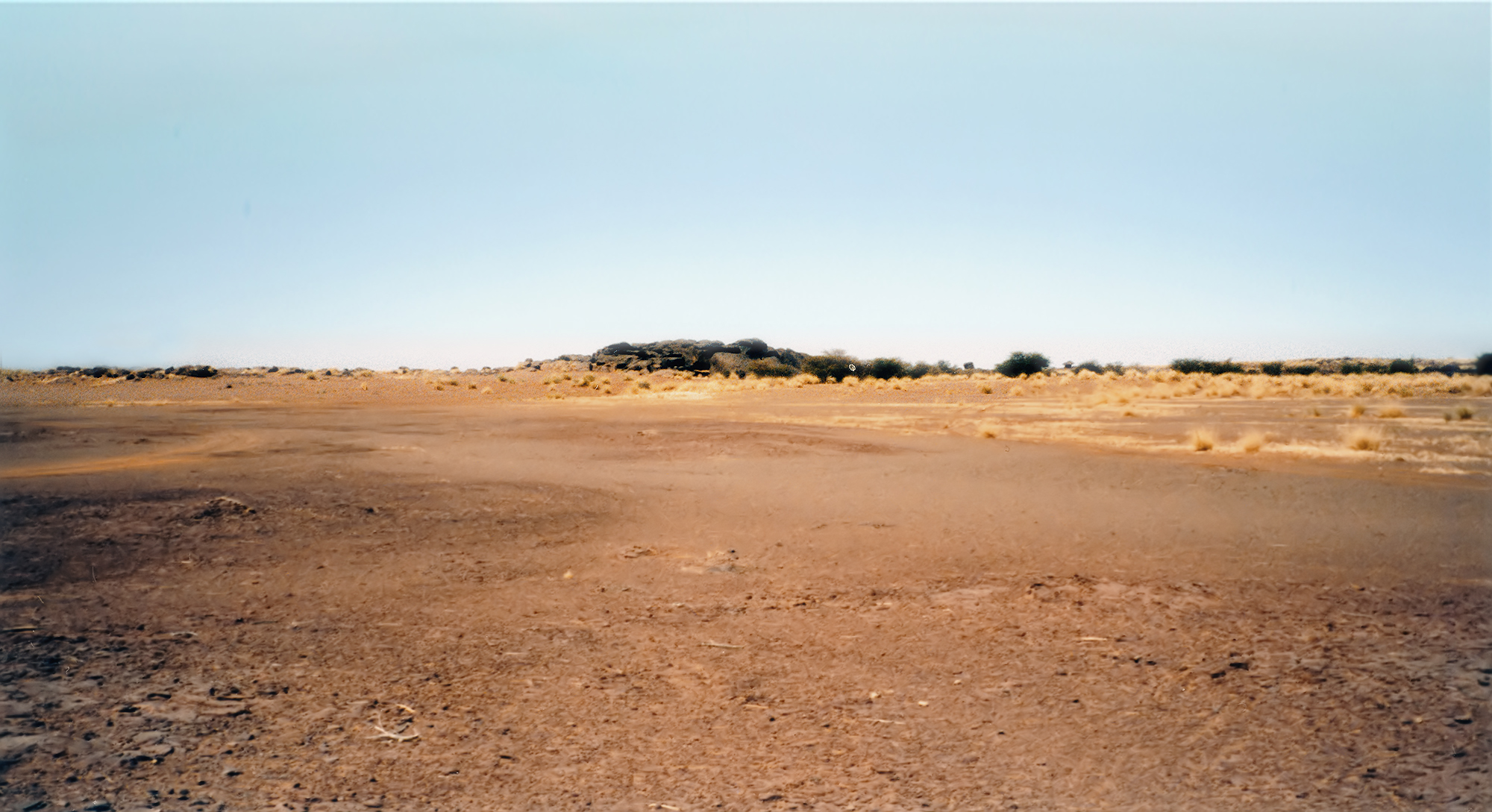
From a distance, the Dabous rock outcrop seems generally unremarkable, and fittingly characteristic of the Tenere desert in which it's found. The Tenere, which literally translates to "where there is nothing," is, today, a barren expanse of desert stretching for several thousand miles between the borders of the Sahara and the Air mountains. The area was not always this arid, nor so seemingly desolate, however, as archaeological research from a nearby extinct lakebed has demonstrated.

Excavation at the once-aquatic site, later dubbed Gobero, began in 2000 by a team led by dinosaur paleontologist and geologist Paul Sereno. Rather than discovering remains of ancient reptiles, however, they encountered a Neolithic burial ground spanning several millennia and featuring two distinct groups (both culturally and ethnically) whose periods of occupation can be accurately mapped onto ancient climatic shifts in the green-ness of the Sahara.


During the early holocene, Gobero was occupied by the Kiffian people. Individuals were generally broadly built and up to 2 meters tall, making them well suited to their hunting lifestyle. Corpses were tightly bound and buried in a utilitarian manner, without associated grave goods. The group did have, however, a sophisticated material culture, complete with bone harpoon points and hooks, as well as a distinctive ceramic style characterized by elaborate wave-like lines. Around 8,000 years ago, the region began to desiccate and its occupation by the Kiffians came to an abrupt halt.


Arid conditions persisted for about 1,000 years, during which the region bore a generally resemblance to what is seen today. Around 6,000 years ago, however, the return to more favorable climates enabled a second occupation of the site by the Tenerian people. The group was distinct from the areas prior occupants both ethnically and culturally. Individuals were of a shorter, leaner build and were cattle pastoralists in addition to engaging in hunting and fishing. Their ceramic culture was less aesthetically motivated than that of the Kiffians, but had a unique material culture which was equally sophisticated. They are associated with a multitude of green rocks found at the site, which were used to make various tools; the discovery of the origin of such stones, which were sourced from the Alallaka quarry 160 km north of Gobero, has informed the understanding of the Tenerians as engaged in systems of long distance trade. The burials, too, bear a marked difference to those of their predecessors as they feature grave goods, evidence of a more developed symbolic dimension to the ritual.


These findings, in addition to providing invaluable depth to our understanding of the history of human occupation of the Sahara as it correlates to the region's changing climate, are key to explaining the origins and significance of the world's largest known petroglyphs. Carved into the sandstone base of the Dabous outcrop are two life-sized giraffes, a male and a female, the larger of which (the male) is over 18 feet tall. First reported by Christian Dupy in 1987, the carvings have continued to deteriorate since their discovery as a result of human pedestrian traffic, graffiti, and the stealing of several fragments for sale on the black market.


The petroglyphs, which Dr. Jean Clottes has estimated to be 7,000-10,000 years old, were produced through several different carving techniques. The deep lines were carved with flint tools, which were harder than the sandstone rock, while petrified wood chisels, found in the sand surrounding the outcrop, are presumed to have been used to wear down groves and polish the rock's surface.


It is hard to object to calling the carvings anything but monumental. Incised on the rock floor of the Dabous outcrop, they are only wholly visible from above; this vantage point, which would be uncommon in the daily lives of their creators, imbued the carvings with a sense of significance, likely even of the supernatural. Lines running from the mouth of each giraffe to small, stylized, anthropomorphic figures have been cited as possible evidence of the ritual use of the carvings by shamans. The line, it is argued, could be a symbolic representation of the transferal of attributes associated with the giraffe, such as the gift of foresight or predication.

Such arguments, while supported by modern ethnographic analogies, cannot be definitively proven. In fact, any theory about the symbolic significance of the carvings are ultimately speculative. We do not know who created them, and we certainly do not know why. Nevertheless, the discovery of the nearby Gobero site, whose occupation overlaps with the estimated date of the carvings' production, has shed invaluable light on the enigmatic depictions.

(A comparison of Kiffanian and Tenerian skulls)


Its discovery gives rise to a myriad of questions concerning the giraffes, such as whether it was the Kiffians or Tenerians who created them. Both groups had the technology to produce such sophisticated carvings, and both had symbolic material culture. The personal ornamentation of the Tenerians, along with their engagement in long distance trade, implies a degree of social complexity which could be cited as evidence for the development of increasingly complex rituals involving such monumental representations. This argument is also supported by the extent of their occupation of the area (about 3,000 years).

The comparative ceramic cultures of the two groups seem to evince the alternate argument, that the Kiffanians created the carvings. The abstract designs on the pottery are the only images associated with either group, and the Kiffian style appears more aesthetically-motivated than that of the Tenerians.

Either argument would be strengthened by evidence that the supposed creators came to the area from a region in which similar carvings, rituals, or giraffe-symbols were found. Serano et al analyzed the skull morphology of both groups, and compared the results to those which characterized various populations in Western Africa. The Kiffian skulls were characteristic of remains from Mali, Mauritania, Maghreb Caspian, and Maghreb Iberomaurusian; the Tenerian skulls could not be associated with any of the tested populations, and further research is needed in order to determine their heritage.


Neither the style nor subject of the carvings were necessarily an external innovation which was then brought to the region, however. The argument for local innovation is supported by the recent realization that the area surrounding the Dabous outcrop is littered with similar, smaller-scale carvings and paintings (see image above). Regardless of the origin of this cultural practice, the degree to which it flourished in the region is indisputable.


Several millennia after the end of its holocene-era occupation, the Tenere desert became a transient home to the Tuareg operators of the Trans-Saharan trade route. Rather than tuareg, an arabic term which means "abandoned by god," these traders called themselves imohag, "free men" in their native tongue. Such histories of the region have been known to westerners for centuries, a fact to which the writings of Herodotus testify. The shift in focus, and therefore valuation, from such cosmopolitan narratives to ones concerning small-scale, tribal societies, however, is as novel as it is necessary.


In 2000, in response to their deteriorating condition, the Bradshaw Foundation endeavored to preserve the carvings by making a mould of them. Immediate action was necessary because of the rate of deterioration; in addition to producing casts in the best possible condition, the process would aid preservation efforts by generating publicity about the site, making its protection a priority. In addition to the mould, the foundation funded the digging of a well which would supply water to a local tribe. The plan was for members of the tribe to act as guides and protectors of the carvings, and by establishing a dependable water source, they were able to ensure the potential for future, grass-roots preservation efforts.

The first cast made from the mould was returned to Niger, and given to the nearby town of Agadez. The town chose to install the cast at their ariport, where it has become a symbol of the heritage of the surrounding region. The Tenere is far from the barren land its name suggests. Narratives of trade span millennia, and ritual sacra 10,000 years old are as compelling as any modern image. Between preservation (i.e. of the surrounding smaller-scale rock art) and excavation (i.e of the 115+ remaining Gobero graves), further efforts are needed to flesh out the story and protect its various chapters, but it seems hard to object to the assertion that such projects seem well on their way.


All images have click-through links to their sources. If any of them are not working, however, it can be assumed that all images of the giraffe petroglyphs (and associated projects) came from The Bradshaw Foundation and images from the Gobero site came from Project Exploration: People of the Green Sahara. Higher resolution images from the Gobero site can also be found in a post from Archaeology.net.


Saturday, November 12, 2011

Skull surgery, the hot new trend.


Examples of 16th century trepanation instruments.

There is a wealth of historical records of the presence of trepanation in many cultures. For the uninformed, trepanation is the (somewhat outdated) process of putting a hole in the skull of a living person, mostly for surgical practices, although the process tends to have more spiritualistic roots. It has been known for a while that the earliest signs of this skull-drilling have been found in numerous forms and in various parts of Europe, South America, the Middle East, and even some parts of Egypt and greater Africa, with findings dating as far back as 3000 B.C. in the Danube River basin, and as far back as 11,000 B.C. in modern-day Morocco. However, a recent archaeological study released this past August suggests evidence of trepanation in a previously unforeseen location.

Anthropologist Efthymia Nikita, along with her colleagues at the University of Cambridge, recently published a paper in the International Journal of Osteoarchaeology outlining the analysis of three skulls of Garamantian men, excavated by past researchers near the ancient capital of Garama (currently southwestern Libya). The skulls contained various styles and sizes of holes and indentations. The Garamantes were a people who thrived in the northern Sahara from around 1100 B.C. to 600 A.D. The paper can be found in its entirety here. *NOTE: a subscription to the journal may be required to view the paper. Columbia students can follow this link, and search for "Evidence of Trephinations among the Garamantes."


Perforation (arrow 1) and depression (arrow 2) in the skull of a Garamantian young adult male.  (Nikita et al, p3) 

In the article, Nikita and her team have surmised that the holes studied in two of the three skulls (Individuals GER011.T20 and TAG012.T3) are concrete evidence of the practice of trepanation in the northern Sahara (Nikita et al, p5). This is an important find for a number of reasons. First, it backs up the evidence of North African trade routes from 2000 - 3000 years ago, since the dates on these artifacts match up with those of other findings of trepanation in other parts of Africa and southern Europe/the Mediterranean. Second, it establishes the fact that humans and material goods were not the only things crossing trade borders during this era.


Trepanations (arrows 1 and 2) in individual GER011.T20. Through a lengthy analysis by Nikita's team, this was discovered to be the skull of a middle-aged man, around 55 years old. Noticeable signs of healing indicate a "successful" surgical procedure, in that the patient survived. (Nikita et al, p3)

According to this article about the finding from Science News, Nikita stated, given the evidence of these trade networks, that "the knowledge of cranial surgical techniques must have been among the cultural traits that spread among populations." This is a significant reveal with regards to the migration and mutation of culture in Africa. The expansion of certain medical practices, including this ancient form of skull surgery, contributes to the various other ideas spread through migration and trade, such as various forms of artisanship.

Most people in the medical community would say that trapanning, being the oldest form of surgery known to man, and once thought to cater an unbelievably wide range of medical circumstances, is somewhat of an obsolete practice. Despite this, there is a group that still thinks it to be a perfectly reasonable practice. The International Trepanation Advocacy Group (ITAG) firmly supports the practice, under the hypothesis that "making a[n] opening in the skull favorably alters the movement of blood through the brain and improves brain functions which are more important than ever before in history to adapt to an ever more rapidly changing world." That debate, however, is for another time.

(As a side note, the wonderfully cliché relaxing background music on ITAG's website provides a great distraction from their sub-par grammatical structure.)

Wednesday, November 9, 2011

The Gentlest Exploitation

One longstanding difficulty in dealing with Africa as a focus of study is its representation, as it has a history of having its history rewritten by outsiders, from explorers to colonialist powers to anthropologists in the modern day. Sometimes it can be easy to spot the heavy hand of Western influence on the African past and its present image, but often the effects are more insidious--and therefore all the more unsettling. I'd like to look at two examples of well-intentioned exploitation of African peoples and their representation: anthropological interaction with the Hadza of Tanzania, and the popular film The Gods Must be Crazy. 


The Hadza are a community in Tanzania that subsist mainly by hunting and gathering, adhering relatively closely to practices that for most of the rest of the world are buried in antiquity. This has led them to be the focus of many anthropologists with points to prove about Homo sapiens' technological and social past. However, their use as an archaeological case study is problematic, as often anthropologists' desire to preserve their "primitive" society results in keeping them impoverished--they are discouraged from the beneficial practice of cattle herding, and since archaeologists don't want to disturb the subsistence patterns that make them so special by compensating their time and involvement with food, the Hadza are often given things of little use for their participation. Planting the Hadza, a contemporary people, in the past is not only a fallacy but a disservice to their history.

A photo from National Geographic's Hadza album, which literally illustrates the temporal paradox surrounding this people: in one photo Hadza hunters wear cargo shorts and plastic sandals, while National Geographic's main article says that these "hunter-gatherers live 10,000 years in the past."

Similarly, in The Gods Must be Crazy (1981), the Kalahari bushmen are depicted as a people outside the world--a people so unlike us in our greed, materialism, and labor-saving devices that they seem more like children than anything else. The film received favorable reviews from many critics but was critiqued by Toby Alice Volkman in a review which discussed its negative impact and implications--mainly in its controversial portrayal of black Africans as either primitive innocents or bumbling gunmen. As Volkman concludes, "[the] San (Kalahari bushmen) are very much of this planet and of this moment. The denial of this reality allows South Africa to continue to dispossess them of their autonomy, their history, and their land."


Two San natives inspect the Western materialism that has touched their community in the form of a glass cola bottle.

Monday, November 7, 2011

Through African Eyes


My first comprehensive course in archaeology was an exposure to a field that was very much unfamiliar to me—a world of highly distinguished archaeologists, anthropologists and other specialists along with their span of theories, hypotheses and suppositions, as well as a myriad of data analyses and interpretations regarding material remains and the archaeological record. Guiding me throughout the semester was my TA, an African graduate student from Cameroon, who had met with me to discuss the topic for my final paper: the passage of time as seen through the eyes of the rural Luo people of western Kenya. I thought that I would begin with a “powerhouse” introduction of key concepts constructed by prominent scholars such as Lévi-Strauss, Bradley, Gosden, Shanks and Tilley, only to be cutoff abruptly. “No, no, stop!” he said. “Stop thinking. Tell me simply what the Luo are perceiving, that is all.” Startled by his comments, I said nothing (most likely I was too afraid to speak much less think). And it was then that I realized how much my “enlightened” perspective was considerably embedded and strangled within the “static” notion of contemporary Western thought. Yet, how do you look beyond yourself, beyond what you know so well? What exactly does it mean to see through African eyes?

These questions bring to mind an article written in 1993 by social anthropologist Tim Ingold titled,
The Temporality of the Landscape. It’s a wonderful study reflecting on the active nature of time within the living environment whose focus also attempts to bridge unifying themes between archaeology and anthropology through an adoption of what he calls a “dwelling perspective” in which the landscape becomes “an enduring record of—and testimony to—the lives and works of past generations who have dwelt within it, and in so doing, have left there something of themselves.” Moreover, Ingold asserts that human life is, after all, a process that involves the passage of time, and for both the native dweller as well as the archaeologist, the landscape relates a story. “It enfolds the lives and times of predecessors who, over the generations, have moved around in it and played their part in its formation.” So in essence, is the archaeologist able to peer through ancient indigenous eyes by “walking around in their shoes,” accessing a past embodied within the earth itself as well as within its material culture?

Considering this question makes me think of the ancestral San and their ardent interaction with the landscape through the multitudinous artistic creations painted boldly across cave walls and boulders throughout southern Africa. Indeed the San clearly impose their wills on these rock faces, rarely conforming to natural backgrounds, for instance, by their extension of outline and color from dark original surfaces onto light exfoliation scars, disregarding any contrasts or for that matter, paintings from previous artists thereby superimposing their conceptions on top of others and embedding the San’s indelible imprints upon the landscape and upon time. In my own effort to envision “a walk in San footsteps,” I dissect photographs of images, and admire the artist’s skill as well as study the composition itself: subject, gender, color, dimensions, ruminating on any possible inherent meanings residing in the works. To enrich my appreciation, I review perspectives from scholars who have endeavored to look through San eyes such as David Lewis-Williams, who describes the graphic rock art as collages of entoptic imagery construed by shamans in trance, generating a kind of “universal ethnography” shared by all humans as these perceptions are not culturally specific; and from John Parkington, who believes that even though the paintings may be informed by an altered state, they are deliberately constructed, built up through a series of choices, and to acquire an understanding of San subjectivity, i.e., achieving an insider’s view, you must consider motive as well as meaning and composition as well as content (Parkington 1989). An additional insight by Africanist Peter Garlake, who asserts, “In Zimbabwe, I have given more weight to the paintings as visual conceptualizations. I see the art as reflecting wider concerns than trance, though focused on the nature of spiritual energy or potency” (Garlake 2002) which compels me to wonder what exactly inspire and propel forces outside the trance state. Yet among these persuasive interpretations, what plainly emerges for me about African rock art is how these “stimulated” visions are as personal as they are unique, individualized experiences. Essentially these artworks even as products of trance encounters or largely informed by them, regardless of whether there is implicit meaning and conceptualization, reside only within the shaman’s own physical eyes with which he is incapable of sharing a direct and specific view of these visual images with others. Perhaps this is where the “act” of creating art becomes a channel for unveiling these intimate insights for those around him and for posterity as he deftly applies paint upon the “canvas.” Indeed no matter how much we try to walk within the footprints of the past, we will never know precisely what is truly perceived much less experienced. And what seems evident is how this vibrant, vivid San rock art has been intentionally endowed throughout the landscape of their time and reaches out to us in the here and now.


Shaman in a Trance, painting by Jean Haynes


This contemporary rendition of a trance-induced shaman emphasizes the eyes that Haynes depicts as two “opaque windows” that will soon illuminate the shaman’s personal experiences through his creations of rock art.


After much “walking” (and a little running), I did finally write about the perception of time conceived by the rural Luo people of western Kenya. And I surmised by the paper’s grade that my TA knew I did my best, that is, I did my best to see through African eyes.


(All photographs are from Google Images)