Wednesday, November 9, 2011

The Gentlest Exploitation

One longstanding difficulty in dealing with Africa as a focus of study is its representation, as it has a history of having its history rewritten by outsiders, from explorers to colonialist powers to anthropologists in the modern day. Sometimes it can be easy to spot the heavy hand of Western influence on the African past and its present image, but often the effects are more insidious--and therefore all the more unsettling. I'd like to look at two examples of well-intentioned exploitation of African peoples and their representation: anthropological interaction with the Hadza of Tanzania, and the popular film The Gods Must be Crazy. 


The Hadza are a community in Tanzania that subsist mainly by hunting and gathering, adhering relatively closely to practices that for most of the rest of the world are buried in antiquity. This has led them to be the focus of many anthropologists with points to prove about Homo sapiens' technological and social past. However, their use as an archaeological case study is problematic, as often anthropologists' desire to preserve their "primitive" society results in keeping them impoverished--they are discouraged from the beneficial practice of cattle herding, and since archaeologists don't want to disturb the subsistence patterns that make them so special by compensating their time and involvement with food, the Hadza are often given things of little use for their participation. Planting the Hadza, a contemporary people, in the past is not only a fallacy but a disservice to their history.

A photo from National Geographic's Hadza album, which literally illustrates the temporal paradox surrounding this people: in one photo Hadza hunters wear cargo shorts and plastic sandals, while National Geographic's main article says that these "hunter-gatherers live 10,000 years in the past."

Similarly, in The Gods Must be Crazy (1981), the Kalahari bushmen are depicted as a people outside the world--a people so unlike us in our greed, materialism, and labor-saving devices that they seem more like children than anything else. The film received favorable reviews from many critics but was critiqued by Toby Alice Volkman in a review which discussed its negative impact and implications--mainly in its controversial portrayal of black Africans as either primitive innocents or bumbling gunmen. As Volkman concludes, "[the] San (Kalahari bushmen) are very much of this planet and of this moment. The denial of this reality allows South Africa to continue to dispossess them of their autonomy, their history, and their land."


Two San natives inspect the Western materialism that has touched their community in the form of a glass cola bottle.

Monday, November 7, 2011

Through African Eyes


My first comprehensive course in archaeology was an exposure to a field that was very much unfamiliar to me—a world of highly distinguished archaeologists, anthropologists and other specialists along with their span of theories, hypotheses and suppositions, as well as a myriad of data analyses and interpretations regarding material remains and the archaeological record. Guiding me throughout the semester was my TA, an African graduate student from Cameroon, who had met with me to discuss the topic for my final paper: the passage of time as seen through the eyes of the rural Luo people of western Kenya. I thought that I would begin with a “powerhouse” introduction of key concepts constructed by prominent scholars such as Lévi-Strauss, Bradley, Gosden, Shanks and Tilley, only to be cutoff abruptly. “No, no, stop!” he said. “Stop thinking. Tell me simply what the Luo are perceiving, that is all.” Startled by his comments, I said nothing (most likely I was too afraid to speak much less think). And it was then that I realized how much my “enlightened” perspective was considerably embedded and strangled within the “static” notion of contemporary Western thought. Yet, how do you look beyond yourself, beyond what you know so well? What exactly does it mean to see through African eyes?

These questions bring to mind an article written in 1993 by social anthropologist Tim Ingold titled,
The Temporality of the Landscape. It’s a wonderful study reflecting on the active nature of time within the living environment whose focus also attempts to bridge unifying themes between archaeology and anthropology through an adoption of what he calls a “dwelling perspective” in which the landscape becomes “an enduring record of—and testimony to—the lives and works of past generations who have dwelt within it, and in so doing, have left there something of themselves.” Moreover, Ingold asserts that human life is, after all, a process that involves the passage of time, and for both the native dweller as well as the archaeologist, the landscape relates a story. “It enfolds the lives and times of predecessors who, over the generations, have moved around in it and played their part in its formation.” So in essence, is the archaeologist able to peer through ancient indigenous eyes by “walking around in their shoes,” accessing a past embodied within the earth itself as well as within its material culture?

Considering this question makes me think of the ancestral San and their ardent interaction with the landscape through the multitudinous artistic creations painted boldly across cave walls and boulders throughout southern Africa. Indeed the San clearly impose their wills on these rock faces, rarely conforming to natural backgrounds, for instance, by their extension of outline and color from dark original surfaces onto light exfoliation scars, disregarding any contrasts or for that matter, paintings from previous artists thereby superimposing their conceptions on top of others and embedding the San’s indelible imprints upon the landscape and upon time. In my own effort to envision “a walk in San footsteps,” I dissect photographs of images, and admire the artist’s skill as well as study the composition itself: subject, gender, color, dimensions, ruminating on any possible inherent meanings residing in the works. To enrich my appreciation, I review perspectives from scholars who have endeavored to look through San eyes such as David Lewis-Williams, who describes the graphic rock art as collages of entoptic imagery construed by shamans in trance, generating a kind of “universal ethnography” shared by all humans as these perceptions are not culturally specific; and from John Parkington, who believes that even though the paintings may be informed by an altered state, they are deliberately constructed, built up through a series of choices, and to acquire an understanding of San subjectivity, i.e., achieving an insider’s view, you must consider motive as well as meaning and composition as well as content (Parkington 1989). An additional insight by Africanist Peter Garlake, who asserts, “In Zimbabwe, I have given more weight to the paintings as visual conceptualizations. I see the art as reflecting wider concerns than trance, though focused on the nature of spiritual energy or potency” (Garlake 2002) which compels me to wonder what exactly inspire and propel forces outside the trance state. Yet among these persuasive interpretations, what plainly emerges for me about African rock art is how these “stimulated” visions are as personal as they are unique, individualized experiences. Essentially these artworks even as products of trance encounters or largely informed by them, regardless of whether there is implicit meaning and conceptualization, reside only within the shaman’s own physical eyes with which he is incapable of sharing a direct and specific view of these visual images with others. Perhaps this is where the “act” of creating art becomes a channel for unveiling these intimate insights for those around him and for posterity as he deftly applies paint upon the “canvas.” Indeed no matter how much we try to walk within the footprints of the past, we will never know precisely what is truly perceived much less experienced. And what seems evident is how this vibrant, vivid San rock art has been intentionally endowed throughout the landscape of their time and reaches out to us in the here and now.


Shaman in a Trance, painting by Jean Haynes


This contemporary rendition of a trance-induced shaman emphasizes the eyes that Haynes depicts as two “opaque windows” that will soon illuminate the shaman’s personal experiences through his creations of rock art.


After much “walking” (and a little running), I did finally write about the perception of time conceived by the rural Luo people of western Kenya. And I surmised by the paper’s grade that my TA knew I did my best, that is, I did my best to see through African eyes.


(All photographs are from Google Images)


Saturday, November 5, 2011

Selam’s Tools


In 2000, a 3 year old Australopithecus Afarensis female named “Selam” (also nicknamed Lucy’s baby) was found in Dikika, Ethiopia. Discovered by Zeresenay Alemseged, the fossils and remains have been dated at 3.3 mya, 120,000 years older than those of “Lucy”. Found merely miles away from Hadar, Lucy’s site of discovery, her specimen corresponds well with that of Lucy’s. Selam skeleton suggests that she was bipedal as well as adapted for tree climbing. The state of the ancient bones, found 400 kilometres northeast of the capital Addis Ababa, suggest she was buried in a flood, which may also have caused her death.

"It represents the earliest and most complete partial skeleton of a child ever found in the history of palaeoanthropology," says Dr Zeresenay Alemseged


Jumping 10 years to 2010, an equally exciting discovery was made in the Afar region of Ethiopia right by the site where Selam was found. Fossils of ancient bones were unearthed with grooves and cut marks, evidence of the use of tools to cut meat away from the bone. Intriguingly, these fossils date back to 3.4 million years ago. Prior to this find by the California Academy of Sciences, the oldest evidence of butchering with stone tools dates to about 2.5 million years ago.

This significant find shows that stone tools were used much earlier than previously thought. Alemseged says it is likely that Selam herself carried stone shards (microliths) and even could have contributed in the butchering the animal remains.

http://www.abc.net.au/science/articles/2010/08/12/2980846.htm

http://en.wikipedia.org/wiki/Selam_%28Australopithecus%29


Monday, October 31, 2011

Naming Names

Zimbabwe is the only country named after an archaeological site, yet although Great Zimbabwe itself dates back to 13th-15th centuries CE, the country has only been officially called by that name since 1980.  From 1923 until 1965, it was a self-governing British colony known as Rhodesia.  Then, in 1965, the country’s white minority declared independence from England illegally, and operated as the Republic of Rhodesia - reinforcing the association with Britain’s chief colonial industrialist, Cecil Rhodes, who founded the British South Africa Company in 1889.  Under the prime minister Ian Smith, and despite UN sanctions, it remained a white supremacist state until 1979, when the black majority came to power under Robert Mugabe.  It was only then that the new country was named after the great pre-colonial ruins that more than anything symbolized the ancient connection to the landscape of the native African population.

The need to name and classify is essential to humans; there is even thought to be a gene for it.  Whenever naming is required, the wheel is reinvented in order to precisely reflect the essence of what the thing or idea being named is.  Fixing its place and defining its identity with specific clarity is essential in order to ensure that when the thing is called by whatever name it is given, no other hands rise in acknowledgement.  In theory, a name reflects the discrete individuality of that which is named; thus Americans saddle their children with badly spelled invented names, although they refuse to amend the Constitution which is seen as written in stone, while France formally regulates the use of the French language through the Académie française and had, until quite recently, an enforced national policy governing acceptable and legally permitted given names.    

Names signify specific individual things.  Churches, temples and mosques are all sacred spaces first, then houses of worship, and then buildings.  But not all buildings are houses of worship, and not all houses of worship are either churches, temples or mosques, and, of those, not all are sacred spaces.  The old nightclub, Limelight, on 18th  street and 6th Avenue was an Episcopal church that was deconsecrated, and repurposed, so that although it remains a building that appears to be a house of worship -indeed, it’s a rusticated brown stone Gothic church with a typical pointed arch door that looks like dozens of other Episcopal churches-  it is no longer the latter, since it is not a sacred space.  Recent developers have made it into an indoor mall while maintaining the church exterior.  Now it is a building that looks like a church -is a church- but functions as an agora, and is neither a house of worship, nor a nightclub, although it could still become a sacred space if the shopping is good enough.  Names and nouns represent things and ideas that are concurrent interdependent parts of both greater categories and smaller groups.  Since these relationships can be of incalculable number, and are simultaneously fluid yet permanent, it is essential that names and nouns maintain their fixed and discrete autonomy.  If one word is changed, everything linked to it is transformed through kinetic reaction.

Assigned names maintain order.  Otherwise, it’s like writing about musicians such as , the Artist (Formerly Known as Prince),  Prince,  or TAFKAP,  and Sean Combs, aka Diddy, P. Diddy, Puff Daddy and now Diddy-Dirty Money.  But that was his name in March.  After that it was Swag, the first expiration-dated name, to be used for one week only starting 5/24/11 and reverting to Diddy  on 6/1/2011.  This analogy is not merely cute, it’s appropriate.  If naming reifies that which is named, then changing its name transforms it to some degree into something else.  Whether it changes so subtly that the shift is invisible, or completely to the point of unrecognizability,  it is nevertheless made fundamentally different.  The act of  of renaming causes uncertainty, shifting the point of view by destabilizing the taxonomic equivalent of the lowest common denominator of language, which is the noun, be it proper or common.

The geographical area currently known as the State of Israel has formerly been known as, in no particular order, Palestine, the British Mandate, the Palestinian Mandate, the Roman Province of Palaestina, Παλαιστίνη, Israel, Canaan,  Philistia, and the Kingdom of Jerusalem, among numerous others.  It has been in the possession of  the empires of Egypt, Greece, Rome, France, Syria, Turkey, Germany, England, and of the Hittites, Assyrians, Babylonians, Mesopotamians, Holy Romans, Byzantines, Ottomans and Mamelukes, at one time or another, and sometimes more than once.  These nomenclatures represent different rulers, their assorted points of view,  and the various desires of past and current territorial occupiers.  Each different name in each different language describes a separate perception of what that landscape represents to the speakers of that language; how it defines the conception of the named place in relation to the observer-speaker.  The names given to the area are not mere translations of the same word and identical ideas, but subtly and profoundly different interpretive identifiers of the same place as viewed by different parties and subject to the idiosyncratic characteristics of the language as well as the time in which the words themselves were forged.

The French named the Eastern Mediterranean le Levant to signify it as the place where the sun rises.  Levant means rising, and the sun really does seem to rise from there, especially if you’re viewing dawn from Western Europe.


Thursday, October 27, 2011

Ibis and the Sacred Animal Necropolis


The Ancient Egyptians are known for their intricate human mummies and their complex journey in the underworld. However, there has been evidence of animal mummies as well. Animal cults, in Saqqara during the Late Period, were at their height. Saqqara is an ancient burial ground in Egypt with numerous pyramids, including the world famous Step pyramid of Djoser. It reflected a period of less troubled times. As Dr. Ikram stated in her book, Divine Creatures, shrines, temples, the embalming and burial of animals were an expression of religious nationalistic feeling. This Late Period with the Greco-Roman Period was decorated with votive animal mummies given as gifts to the gods. Tons of animals were embalmed during this time: fish, cows, bulls, sheep, cats, dogs, baboons, jackals, ibises, falcons, hawks, crocodiles, shrews, scorpions, and snakes were all included. Most of these animals were chosen because they had something to do with or had a specific relati
on to the Egyptian gods. Animal mummies were important throughout rituals from the beginning of the Ptolemaic period, around 305 BC, through to the Roman period.


I have always been extremely fascinated with the
Egyptian depiction of animals and their roles as gods. It just seems like a beautiful concept to look for admirable traits in nature and identify with animals. When I went to the Metropolitan Museum of Art earlier this month, I noticed a particular shelf of animals displayed. The animals were so tiny and carved so intricately, I could not fathom the kind of craftsmanship that goes on to make these. Each of these creatures are so finely detailed, it is absolutely incredible. In search of focusing on one animal in particular, I chose the ibis bird because there is so much literature about ibis mummies and how Egyptians valued this bird and preserved the ibis to the afterlife.


There are over 5 million ibis mummies at Saqqara
and it is estimated that there were over 10,000 birds buried annually in ibis catacombs. Another discovery from the Third Dynasty shows ibis mummies in lidded pottery only 700 meters away from the Step Pyramid enclosure. One large tomb of the Third Dynasty had the remains of sacrificed bulls around it and fragments of Ptolemaic-Roman offering pots with the remains of ibis mummies. Another excavation showed the skeleton of another bull laid on clean sand and hundreds of ibis mummies in their lidded pots. Some of them were elaborately wrapped with appliqués connecting them with Thoth and Imhotep. This complex is known as the South Ibis Catacomb. Cemeteries filled with mummified
ibis birds have been found at Abydos and near Hermopolis.


The ibis bird, which belongs to the stork family, was regarded in particular as sacred and worthy of burial and mummification. Ibis is also a hieroglyphic symbol. Revered in ancient Egypt, Ibis was associated with wisdom and the ibis-headed god Thoth, who was the scribe of the gods, god of learning, and a deity. Thoth gave the hieroglyph of life to Osiris. Thoth could also be represented as the baboon and North Saqqara was a burial place for both animals.

These burials and shrines at Saqqara became a place pilgrims would come for to pay respects to, especially to the god Thoth. At Saqqara, the cult of the relatively unknown deity Thutmose, a young ibis, was particularly popular among women.


Ibis mummies were mummified with their feet grasped and plunged into a vat of liquid resin. Then they were elaborately wrapped in linen bandages. Often times they were placed into ceramic jars which later were placed into catacombs. Some of the mummies were set rigid with palm-ribs, which was the same technique used on human mummies. Mummification of the ibis included desiccation and evisceration. Large volumes of ibises have been found and understood to have been specially reared in or around the temples. At the Sacred Animal Necropolis at Saqqara, several ibis eggs in a courtyard have been identified as the ibis hatchery. Ibis temples have also provided information for specific breeding sites.

Anthropologists and archaeologists are debating and tackling the questions why the extreme increase in animal mummies happened during the Greek and Roman rule. Edward Bleiberg, the curator of Egyptian, Classical and Ancient Near Eastern Art and the Manager Curator of Ancient Egyptian, African and Asian Art of the Brooklyn Museum suggests there is a connection with traditional ancient Greek animal sacrifice, since these Egyptian animals were certainly sacrificial since x-rays show that the majority of them died young in a violent death. Was there a fusion of a new culture? Archaeologists are still researching the significance of these animal mummies.


Below is a video link describing the process of animal mummification:

Dr. Salima Ikram Explains How Animal Mummies Were Made


Sources:

Giakoumis, Melina. "Return of the (Brooklyn) Mummies." Archaeology Magazine. 16 Aug. 2010.

Ikram, Salima. Divine Creatures. Cairo: American University in Cairo, 2005.

Tuesday, October 25, 2011

The Limits of Linear Thinking

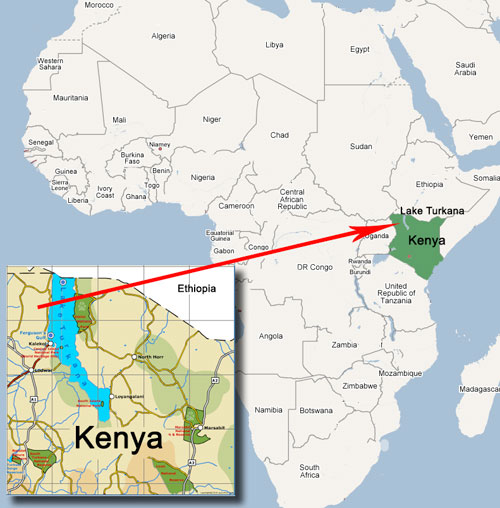
http://turkanamissions.org/images/map.jpg
Location of Discovery

Researchers at Columbia University's Lamont-Doherty Earth Institute recently dated Acheulean tools found in Lake Turkana, Kenya as 1.76 million years old, making them the oldest known specimens of this type. Previously, Acheulean tools were believed to have developed between 1.4 to 1.6 million years old.

http://lithiccastinglab.com/gallery-pages/handaxespointedtripsm.jpg
Acheulean Tools

The tools were discovered in a sediment level which also contained Homo erectus skulls, indicating that this species was responsible for their production. Interestingly, Oldowan artifacts were found alongside the Acheulean ones. The Oldowan tools consisted of sharp stone flakes and rock cores. Oldowan technology, described as "earlier and simpler" in the New York Times Article "Earliest Signs of Advanced Tools Found," is believed to have originated around 2.6 million years ago.

http://science.nayland.school.nz/graemeb/images/class%20work/2005/yr13images/evolution/toololduan.gif
Oldowan Tools

The idea that the two technologies could coexist should not be surprising, yet the Times article makes a point of stating, "It was possible that the Acheulean technology was imported from a place yet to be identified," before acknowledging the possibility that it originated within the area. Even after the idea of local development is addressed, the article quotes "archaeologists and geologists" involved in the discovery as "concluding that there may have been multiple groups of hominids 'distinguished by separate stone-tool-making behaviors and dispersal strategies' co-existing in Africa 1.76 million years ago."

The article does not (probably deliberately) incorporate terms associated with a linear archaeological timeline, such as Old Stone Age, Early Stone Age, or even Modes 1 and 2 (terms which correspond, respectively, to Oldowan and Acheulean technologies). However, the references to Acheulean tools as "more advanced" and "more sophisticated" than the Oldowan ones indicate the pervasiveness of the underlying assumption that evolution follows a linear progression.

The article's subject, the discovery of the coexistence of both types of tools, contests this assumption, yet the author still manages to incorporate it. The idea that the Acheulean technology must have either been brought in from an outside source or developed by groups separate from those using Oldowan technology ignores the possibility that one group could be using both types of tools at once. Perhaps Oldowan tools were better suited for certain purposes, they were easier to make, or the materials used to make them were more readily available and thus groups continued to make them alongside the Acheulean ones.

Dr. Ian Tattersall of the American Museum of Natural History was quoted in the article as being surprised that "the Acheulean evidently didn't catch on widely for several hundred thousand years after it was invented." It makes sense that he would be surprised if the existence of a linear timeline is taken for granted - why would anyone continue to use an outdated and rudimentary tool when given the option of a newer model? The fact that the two types coexisted indicates that there is no linear progression from one to the other, and therefore it is inaccurate to classify Oldowan technology as less advanced just because it developed first.

In fact, Mode 5 microliths, often classified as the "most advanced" form of Stone Age tools, have been discovered at Howieson's Poort and Stillbay in South Africa dated between 70,000 and 65,000 years ago. However, the use of these microliths disappeared, and the Mode 3 technology returned. The Mode 5 microlithic technology did not reappear again until thousands of years later. The Mode 3 prepared cores must have served some purpose, then that the Mode 5 tools could not fulfill at the time, indicating that the Mode 5 microliths are not necessarily more useful or more refined. This example demonstrates the incompatibility of a purely linear framework with archaeological evidence.

The assumption that certain technologies are inherently better than others is especially problematic given that certain groups still use stone tools in their everyday lives. Ethnographic analysis of these groups, then, can place them in the past without acknowledging their histories and their change over time. Although archaeologists have attempted to move beyond C.J. Thomsen's Three-Age System, they have, for the most part, simply created new idioms for their linear timelines. Even when the archaeological evidence visibly contests this notion, there can be a tendency to try to interpret it in a way that remains in accordance with these deeply embedded assumptions. In order to accurately analyze the actions of ancient hominids, how can we rid ourselves of the restrictions inherent in linear thinking?

Sources:

Friday, October 21, 2011

Painting the Picture of the Past


Dr. Sada Mire is a department member of the institute of archaeology at the University College of London. Doctor Mire, focuses her research interests on culture heritage management, archaeological and anthropological theory and practice. In 2010,
Dr Mire headed a local team to Africa, where they uncovered cave paintings at over 100 different and unknown sites. Reporter Dalya Alberge of The Guardian in the United Kingdom, covered this story.

"UK archaeologist finds cave paintings at 100 new African Sites: Scientist unearths 5,000-year-old rock art, including drawing of a mounted hunter, in Somaliland." Some of the rock art found by Mire and her team has been dated back to 5,000 years ago. Interestingly, one of these pieces has been identified as one of the earliest depictions of a mounted hunter. Similar to many of the pieces that archaeologists have found up to this point, the cave paintings include animals such as antelopes, giraffes, and snakes. However, according to Alberge's interview, Dr. Mire was noted as saying, "These are among the best prehistoric paintings in the world." The clarity of these works are unmatched, but is that a matter of quality? Or the lack of their
exposure?

In the article, Mire is cited, "Yet Somaliland is a country whose history is totally hidden. With wars, droughts and piracy in Somalia, hardly anyone has researched the archaeology until now. But its absolutely full of extraordinary well-preserved rock art." But is it really Somalia's turmoil that has made Somaliland an archaeological black hole? This is a large issue in respect to the development of Africa's cultural history. So many areas of Africa have been left unexplored. Not only is it a detriment to the representation of African history, but also a downfall in the outside world's understanding of a truly brilliant culture. These examples of ancient artwork reflect the vast abilities of early human populations. Their ability to depict their surroundings, use artistic techniques such as a variance of mediums, use art as communication, these abilities should not be neglected.

As a Somali-native, Dr. Mire took some stabs as to the meanings of some of the rock art she and her team found. In Dhambalin, an area about 40 miles from the Red Sea, features different pastoral animals: cattle, sheep and goats. Mire notes that the animals "have distinctive bands around their backs and bellies, which suggests farming or ritual traditions." Additionally, some of the more recently dated pieces, are "more mysterious." These include images of the moon in different stages and other geometric signs. The doctor believes these images "depict the ancient artists' view of the world, time and space." Of course these interpretations could be wrong, but her discoveries could be the catalyst for a much needed expansion of archaeological Africa.


How can we allow ourselves to overlook such a crucial part of evolution, the origins of our population? When it comes to exploring the origins of the African population and the evolution of the human population as a whole, it is not sufficient to only examine a selected few areas of a large and highly influential continent. Authors such as Diop and Posnansky have touched upon the need for the development of African Archaeology, and Dr. Sada Mire is on the right track. In my opinion, these findings are huge in the development of our archaeological knowledge. What we need is the further exploration of areas that are completely unknown. Extensive research has been done in some African states, like Egypt for example, which is a great start. However, it is the areas less known that may give us some of the answers we are looking for.

There is an incredible amount of information to uncover, but there are needs to be the desire from archaeologists willing to walk on paths unpaved.

1. http://www.guardian.co.uk/world/2010/sep/17/cave-paintings-found-in-somaliland
2. http://www.soas.ac.uk/staff/staff59125.php